

Medically reviewed by Dr. Jaramillo, a doctor at Goodweigh. Last updated on 8 October 2026
Short answer from Dr. Jaramillo
You inject Ozempic once a week subcutaneously, into your stomach, thigh or upper arm. For each injection, fit a new disposable needle, set your dose and insert the needle. Hold the button down until the counter reaches 0, then count slowly to 6 before removing the needle. Always have a doctor or healthcare professional demonstrate the technique to you the first time.
Dr. Jaramillo, doctor at Goodweigh
Want to find out more? Start your intake here
An Ozempic injection sounds more daunting than it actually is. The pen does most of the work: you just insert the needle, turn the dial and press down. However, things can sometimes go wrong when checking a new pen, if the needle is blocked or if you cover the window. You’ll find all the steps here: where to inject, how often, what to do if you miss a dose, and how to store the pen.
Ozempic is injected under the skin, not into a vein or muscle. Each pen comes with instructions for use, including illustrations, at the back of the patient information leaflet.
What do you need for an Ozempic injection?
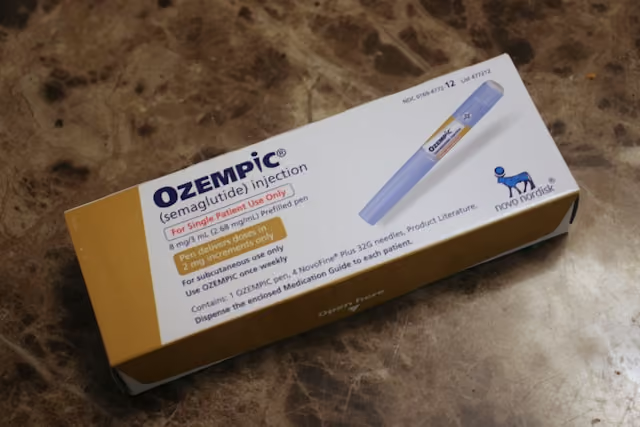
You will need an Ozempic pen, a new needle and a safe place to dispose of the used needle. The pen is designed for disposable needles ranging from 30G to 32G and up to 8 mm in length, and NovoFine Plus needles are included in the pack. Use a new needle for each injection to prevent contamination and blockages, and never use a bent or damaged needle.
An international guideline on injecting for diabetes recommends shorter needles (such as 4 mm), as these allow for safe subcutaneous injection with minimal pain. Dispose of all used needles safely in a needle container, as advised by your pharmacist or local authority.
How do you administer an Ozempic injection, step by step?
You administer the injection in five steps: prepare the pen, check the new pen, set the dose, inject and remove the needle. These are the steps in the Ozempic instructions for use. Make sure you are supervised by a doctor or nurse the first time you do this: this is also stated in the patient information leaflet.
Step 1: Prepare the pen and the needle
Check the label, make sure the solution is clear and colourless, and fit a new disposable needle, as using the wrong product could be harmful. Remove the cap. If the solution is cloudy or coloured, do not use the pen.
Take a new needle and check that the paper cover and the outer needle cap are intact. Remove the cover, push the needle straight onto the pen and twist it into place. Then remove both caps: the outer one and the inner one. You won’t be able to inject anything without them. Keep the outer cap for later.
Step 2: Check the flow on a new pen
Before using a new pen for the first time, turn the dose dial to the flow control symbol; this is often referred to as ‘priming’. Press the button until the counter reads 0 and a drop appears at the tip of the needle.
If you cannot see a drop, repeat the check up to six times. If that does not help, replace the needle and carry out the check once more. If nothing appears then, throw the pen away and get a new one. Never inject if no drop appears, even if a different number is shown in the window. The needle may be blocked or damaged.
Step 3: Set the dose
Turn the dose dial until the window stops at the dose prescribed by your doctor. Only the window and the pointer arrow show which dose has been set: so do not count the number of clicks. Do not cover the window with your fingers, as this may interrupt the injection.
Each Ozempic pen has a fixed strength, and you can only set that dose. Never change the dose yourself. You can find out more about dosages in the semaglutide titration schedule.
Step 4: Inject
Choose a spot on your stomach, thigh or upper arm. Insert the needle into the skin as your doctor or nurse has shown you. Press the injection button all the way down and hold it down until the window reads 0. Keep pressing and count slowly to six, with the needle still in the skin.
If you remove the needle too soon, you may see a small stream of liquid coming from the tip of the needle. This means that the full dose has not been administered. However, a single drop at the tip of the needle afterwards is normal and does not affect the dose. If the injection site starts to bleed, apply gentle pressure to it.
If the window does not reach 0, even after pressing and holding, you have not received the medicine. The needle is probably blocked or damaged. Replace the needle and start again from step 1, using the full dose.
Step 5: Remove the needle and put the pen away
After each injection, remove the needle from the pen. Place the outer cap on a flat surface and guide the tip of the needle into it, without touching the cap or the needle. Press the cap down firmly, unscrew the needle and dispose of it. Never attempt to put the inner needle cap back onto the needle. Then replace the pen cap on the pen to protect it from light.
Never store the pen with the needle still attached. Do not share the pen or needles with anyone.
Where do you inject Ozempic?
You should inject Ozempic into the front of your upper thighs, your stomach or your upper arm. Do not inject immediately around your navel. Vary the injection site with each injection, even within the same area, to prevent skin thickening, lumps and tissue damage (lipodystrophy). This is also recommended in the Wegovy patient information leaflet and the injection guidelines.
If you are visually impaired or blind, do not use the pen without assistance from someone who is familiar with it.
Does an Ozempic injection hurt?
An injection site reaction sometimes occurs, affecting fewer than 1 in 100 users. These include bruising, pain, irritation, itching or a rash, as described in the Ozempic patient information leaflet. In a short study involving people who had never injected themselves before, almost everyone found a weekly single-use pen of another GLP-1 medication (dulaglutide) easy to use.
If a reaction persists or gets worse, please contact your doctor. According to the Farmacotherapeutisch Kompas, nausea and diarrhoea are very common side effects of Ozempic, affecting more than 1 in 10 users. Vomiting and constipation are common. Further information can be found under ‘semaglutide side effects’.
How often and on which day do you inject Ozempic?
You should take Ozempic once a week, preferably on the same day each week. It doesn’t matter what time of day you take it, nor does it matter what you’ve eaten: you can have the injection at any time of the day. Make a note of the day of the week and the date on the box.
If you want to change the day, you can do so as long as there are at least three days between your last injection and your next one. After that, you’ll go back to having an injection every week, on the new day.
What if you forget to take an Ozempic injection?
If it has been five days or less since you should have had your injection, take the dose as soon as you realise. Take your next dose on the scheduled day as usual. If it has been more than five days, skip the missed dose and resume your injections on the scheduled day.
Never take a double dose to make up for a missed dose. If you miss several doses, consult your doctor to find out whether you should start again on a lower dose.
How should you store the Ozempic pen?
Store a pen you have not started using yet in the fridge, not in the freezer and not against the cooling element. A pen that is in use may be kept below 30°C or in the fridge. It will then stay usable for six weeks, or eight weeks in the case of a pen containing eight doses. Put the pen cap back on when you’re not using the pen.
Do not leave the pen in a hot or cold car, and do not expose it to direct sunlight, dust or moisture. If the pen falls, fit a new needle and check the flow before injecting. Further tips can be found in the section on storing Ozempic.
What is the difference between this and the Wegovy FlexTouch?
The Wegovy FlexTouch works largely in the same way as the Ozempic pen, with three minor differences. With Wegovy, you choose a spot on your stomach, thighs or upper arms, at least 5 cm away from your navel. When checking a new pen, if no drop appears, you’re only allowed to try again twice, compared to six times with Ozempic. And Wegovy comes in five pen variants, each containing four doses; so always check the label.
The other steps are the same. Always read the instructions for use provided with Wegovy. You can find out more about the medicine on the Wegovy page.
Where can you find a tutorial video or help?
You’ll find instructions with illustrations in the user guide at the back of the leaflet that comes with your Ozempic pen. The first time you use it, ask a doctor or nurse to show you how it works. If you’re unsure or something goes wrong, call your doctor or pharmacy.
Frequently Asked Questions
Do you need to prime Ozempic?
You should only check the flow, known as the ‘flow check’, before giving the first injection with a new pen. Press the button until a drop appears at the tip of the needle. You do not need to do this with a pen that is already in use.
How long does an Ozempic pen last once it has been opened?
Once first used, the pen can be kept for six weeks, or eight weeks in the case of an eight-dose pen. Store it at a temperature below 30°C or in the fridge, with the cap on. If the pen has been frozen, do not use it.
Where do you inject Ozempic, into your leg or your tummy?
Either is fine. Choose the front of your thigh, your stomach or your upper arm, and alternate the injection site. Do not inject into a muscle or a vein.
Can you have the injection a day earlier?
Yes, provided there are at least three days between your last injection and the next one. After that, carry on injecting on the new day. Do not change the dose yourself.
What do you do if no drop appears or the window doesn’t show 0?
In that case, the needle may be blocked or damaged. If no drop appears, do not inject. If the window does not show 0, you have not received any medicine. Replace the needle and start again.
Quellen
Frid, A. H., et al. (2016). New insulin delivery recommendations. Mayo Clinic Proceedings, 91(9), 1231-1255. https://pubmed.ncbi.nlm.nih.gov/27594187/
- Matfin, G., et al. (2015). Safe and effective use of the once weekly dulaglutide single-dose pen in injection-naive patients with type 2 diabetes. Journal of Diabetes Science and Technology. https://pubmed.ncbi.nlm.nih.gov/25901022/
- Zorginstituut Nederland. Semaglutide. Farmacotherapeutisch Kompas. https://www.farmacotherapeutischkompas.nl/bladeren/preparaatteksten/s/semaglutide
- European Medicines Agency. Ozempic: productinformatie (bijsluiter). https://www.ema.europa.eu/nl/documents/product-information/ozempic-epar-product-information_nl.pdf
- European Medicines Agency. Wegovy: productinformatie (bijsluiter). https://www.ema.europa.eu/nl/documents/product-information/wegovy-epar-product-information_nl.pdf
Your Final Weight Loss Program
Transform your life with our personalized telehealth weight loss program designed for lasting success.